Download the album in mp3 format here. It’s a zip file, so you may need to double-click it to expand the contents, and drag them into iTunes, or whatever digital music player you’re using.
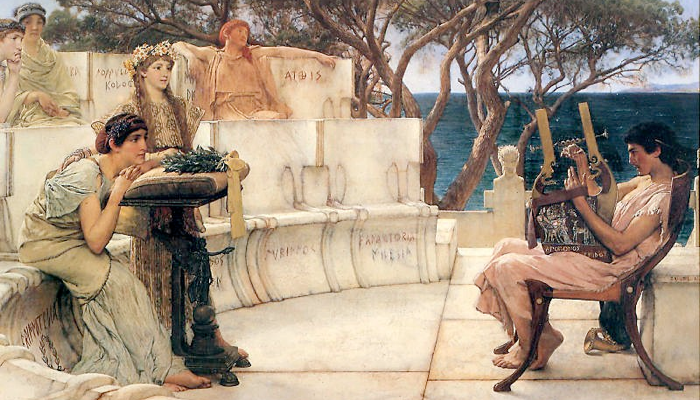
The word “guitar” comes from the ancient Greek kithara. Greek stringed instruments were divided into two types, the kithara and the lyra: both looked like lyres to us, but they were physically different and had different social roles. The kithara was the upper-class instrument, the one associated with virtuoso performances and professional musicians; the lyra was the popular instrument, the one that anyone could grab next the campfire on the beach, start strumming, and everyone would sing “Stairway to Heaven” to. The word kithara had an incredible resonance linguistically and historically. In India, it became a stringed instrument that is fairly well-known in the West, thanks to the Beatles: the sitar. In Western Europe, it became the guitare in France, the guitarra in Spain, the chitarra in Italy and the guitar in England (the unusually conservative Italians have in fact preserved the word closest to the original ancient Greek)—not to mention the cittern. (A side note on etymologies: the word “lute,” the guitar’s first cousin, comes from Arabic al-’ud, literally “the wood.” This became the origin not only of the word “lute” and “luthier”—guitar-maker—but also of the oud, still a popular Middle Eastern instrument, rather like a fretless lute.)
The bass version of the kithara was called the barbiton. My bass-playing brother will be amused to learn that it was tuned an octave lower than the kithara, was regarded as a “barbaric instrument” by Hellenic Greeks, was used for music at drinking parties, and that the bassist and lyricist Anacreon (582-485 BCE) claimed that his barbiton only gave out “erotic tones.”
Both the lyra and the kithara traditionally had seven strings (both started off with four, but grew more ambitious, like Steve Vai), and were used like a modern autoharp, which is technically not a harp, but a zither. (And you’ll never guess where the word zither—also be written citer, citre or citera—comes from…). All strings were strummed with the right hand, holding a pick, and the left hand would mute the strings that produced unwanted pitches. In short, a strumming instrument designed for accompaniment, and not able to play many melodies.