Review and Preparation for Weeks 3, 4, and 5, Lectures 5 through 9.
Jane Austen (1775-1817)
Persuasion (1818--completed 1816)
1. Consulting the map on the inside of your Norton (Volume I), mark
the following (perhaps shade the county in pencil?):
--Somerset = Somersetshire: the county where Kellynch Hall is situated.
--Bath = the health resort to which the Elliots move.
--London = the city too expensive to be helpful to their new economic
regimen.
2. Examine the opening statement of the novel very closely. Some of the motifs with which the novel is most preoccupied are introduced here. Write down your observations taking special note of the way the sentence is structured.
3. Write a brief synopsis of the historical moment in which the novel is set. What year is it? What has been happening between Britain and other European nations? How is this different from 1806, when Anne Elliot first knew Captain Wentworth? [Look carefully at Chapters I, III, and IV.]
3. You will find it easier to understand this novel if you map very
carefully the social and class relations of the characters. For instance,
--What is the difference in the social status of Sir Walter Elliot
and Lady Russell? Do both of them appear in Debrett's Baronetage? (Look
in the second chapter).
--Why does Lady Russell persuade Anne Elliot against marrying the man
she loves?
--As the novel progresses, take notes on the question of whether Jane
Austen seems to endorse the values of the aristocracy or of the rising
professional classes. Where do the working classes fit in, or do they?
[Some phrases that you may find helpful to remember here are: "landed
gentry"; "a country gentleman"; "to be in trade"; "to show good breeding";
"to be vulgar"; "to be genteel"; "to be sensible" or "respectable" or "to
behave with due propriety." Many of these phrases seem quaint and even
alien in twenty-first-century America, don't they? As you read, accumulate
as many of these phrases as you can so that you can articulate the fine
nuances of behavior that to us may seem very petty, but within the framework of the novel, are important to the critical judgments that the characters make.]
4. When we studied Mary Wollstonecraft, we listed some of the attributes she most despised and some she most advocated in her female contemporaries (the numbers refer to the page numbers in the Norton where you can find illustrations):
A. Despises:
--174/170 ignorance that poses as innocence
--189/185 the wish only to please and take pleasure
--194/191 artificial graces that encourage cunning and tyranny
B. Advocates:
--180/177: a mind independent and worthy of moral respect
--182/178: strength of body and exercise of mind
--191/187: power over the self (self-discipline), not over men
Many of Jane Austen's female characters reflect precisely these attributes. Make yourself a list of the characters, the attributes they exemplify, specific instances in the novel when they reveal these characteristics, and what the consequences of their behavior are. Are the virtuous necessarily rewarded?
5. Watch carefully for references to Romantic poetry, even if it is
not necessarily the poetry you have read. Does the novel encourage the
reading of poetry, particularly by young women?
Percy Bysshe Shelley (1792-1822)
1. "Mutability" describes human existence as ephemeral. Does it offer
any consolations for this impermanence?
John Keats (1795-1821)
1. What does Keats mean by the "Negative Capability" of a poet and what kinds of poetic style does it produce?
2. Paraphrase what you think he means by the opposition of "the wordsworthian or egotistical sublime" to the "camelion Poet."
3. How do these theoretical positions affect Keats's role as a "Romantic" poet?
4. In both Keats's "Ode to a Nightingale" and Shelley's "Ode to the
West Wind" the lyric speaker sets out from a sense of world-weariness that
he attempts to transcend.
Describe the strategies each uses to escape his
forlorn condition. Is one more successful than the other in your opinion?
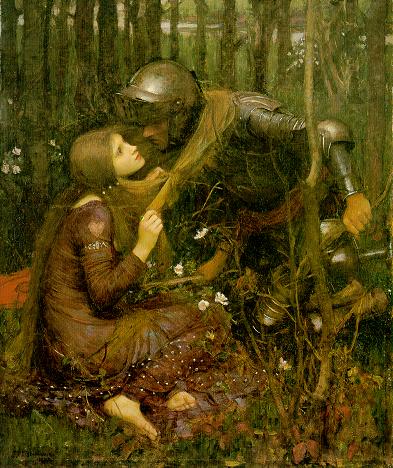
5. Consider the two images presented below. What is
it about Keats's poetic style that might invite a painter to reproduce
the poet's ideas in pictorial form?
Image 1:
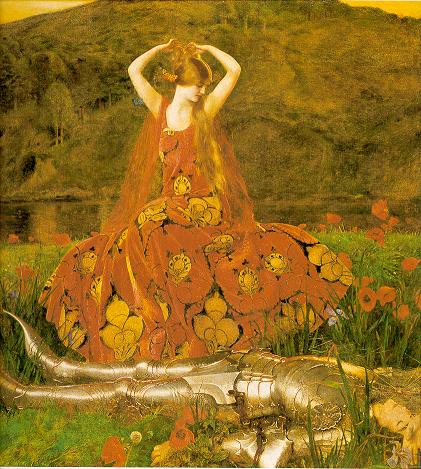
Image 2:
"La Belle Dame Sans Merci" by John William Waterhouse (1893)