
Transcription
We provide transcriptions in Deseret and SAMPA of the Deseret portions of Thales Hastings Haskell’s journal, covering 4 October 1859 through 1 January 1860. These entries record his experiences as a missionary among the Hopi with his companion, Marion Jackson Shelton.
About the Journal
Haskell, his mission, and his journals
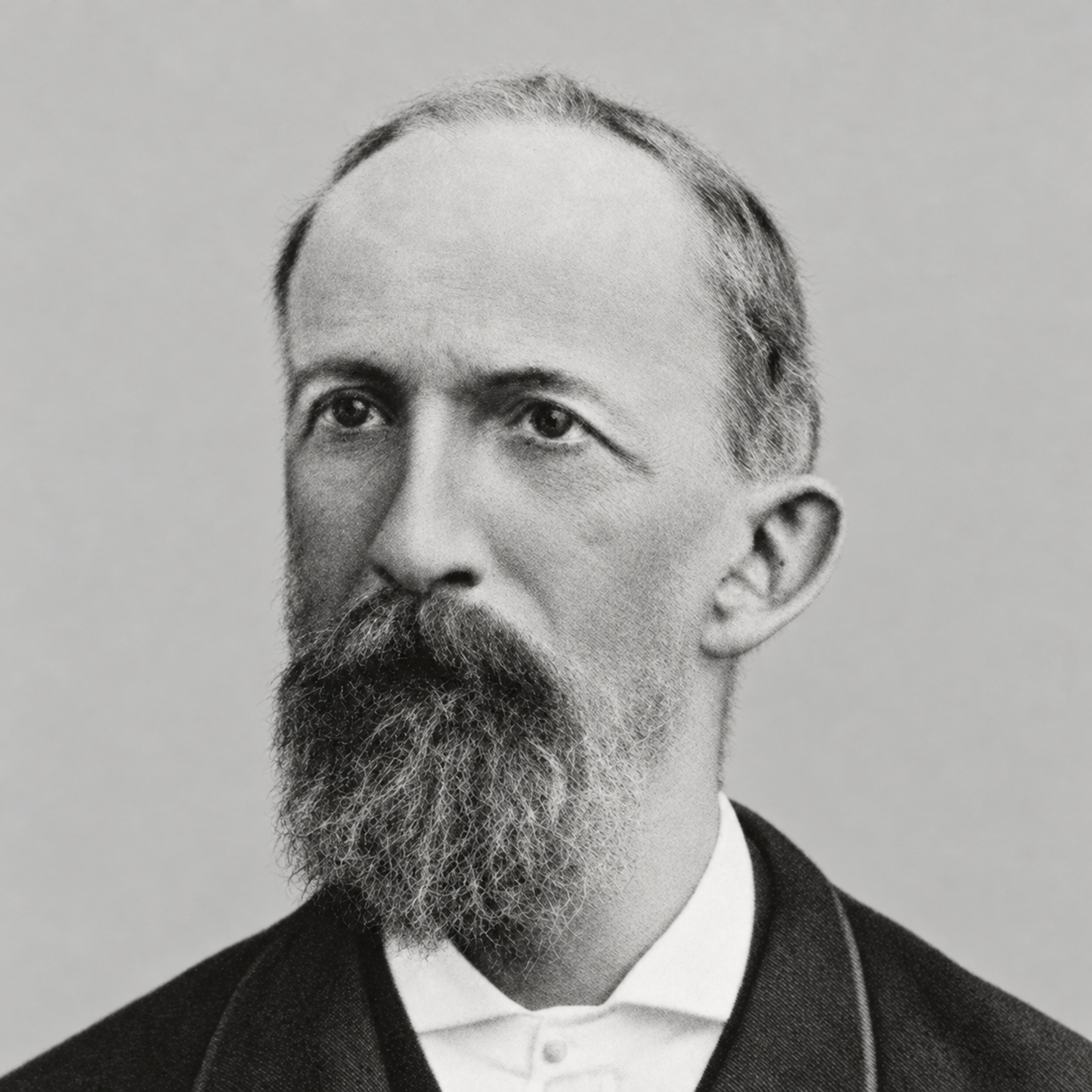
Thales Hastings Haskell was born on 21 February 1834 in North New Salem, Massachusetts. He traveled west with his family as a child and reached the Salt Lake Valley in 1847. His journal of 1859–1860 records a journey that took him from southern Utah into Hopi country, in what is now northern Arizona. Two versions of this journal survive, one in the Roman alphabet and another, covering only part of the journey, in the Deseret Alphabet.
Questions of precedence
The relationship between Haskell’s Roman-alphabet and Deseret Alphabet journals remains uncertain. Haskell may have kept a journal in Roman letters throughout his travels, copying portions into the Deseret Alphabet during his residence at the Hopi village of Oribe (Oraibi). His companion Marion J. Shelton was actively using the Deseret Alphabet at the time, and the transcription may have been undertaken partly as an exercise in the new writing system. The surviving Deseret text ends abruptly on 1 January 1860, whereas the Roman-alphabet journal continues through March, recording the conclusion of Haskell’s mission and his return to Utah. This difference is consistent with an unfinished Deseret transcription, although it does not establish which manuscript was written first.
Comparison of the two versions suggests that Haskell was not simply copying mechanically. The Deseret text contains interlinear additions, corrections, and occasional differences in wording and narrative sequence. For example, in an account of watering the animals and filling canteens, the phrase “plenty of wood and good feed at this place” appears as an addition above the Deseret text but forms part of the continuous Roman account. Similarly, Haskell inserted village after the place-name Oribe in Deseret, where it already appears in the Roman version. These additions could represent words inadvertently omitted during transcription and subsequently restored from the Roman text. Equally, however, they might be revisions incorporated into a later Roman copy from an annotated Deseret original.
Other differences suggest that the relationship between the manuscripts was not one of strictly verbatim transcription. An estimated distance of “some 10 miles” in the Roman journal appears as “some 8 or 10” in Deseret, while the Roman expression “an Indian camp” is represented in Deseret by an apparent Paiute name, 𐐿𐐪𐑂𐐨𐐻𐑅𐐮𐑆, possibly referring to the Kai’vi’vits. In an episode involving runaway mules and a sack of spilled beans, the order of events also differs between the two accounts. Such variations indicate that Haskell sometimes clarified, expanded, abbreviated, or rearranged his narrative, but they do not consistently establish the direction of copying.
One correction offers more specific, though still inconclusive, evidence of sequence. Haskell changed falls to pours in the Deseret manuscript, while the Roman journal retains falls. This could indicate that he copied the Roman wording into Deseret and then revised it, leaving the Roman text unchanged. It is also possible, however, that the Roman version was copied from the Deseret manuscript before this correction was made.
Two entries in the Roman-alphabet journal provide particularly important evidence that Haskell was engaged in retrospective copying during his residence at Oraibi. On 22 January 1860, three weeks after the final surviving Deseret entry, he wrote, “Made me a book and copied Journal.” On 27 February he recorded that he “Wrote back Journals.” These remarks establish that at least some of his journal-writing involved copying earlier material rather than recording events as they occurred. Neither entry identifies the alphabet in which the source or copy was written. Nevertheless, the January reference to making a book raises the possibility that the surviving Roman-alphabet manuscript was itself produced, at least in part, as a retrospective copy. If so, its earlier entries need not represent the original record of the journey, even if they preserve wording that preceded the Deseret version.
The available evidence therefore supports the existence of a process of copying and revision, probably undertaken while Haskell was living at Oraibi, but does not conclusively establish the precedence of either surviving manuscript. A Roman-alphabet working journal subsequently transcribed into Deseret remains a plausible explanation, particularly given the unfinished state of the Deseret text. Yet the reverse sequence, or the possibility that both manuscripts were copied from earlier notes or another journal, must also be considered. A codicological comparison of the surviving manuscripts—including their paper, binding, pagination, ink, handwriting, corrections, and evidence of retrospective composition—is needed to determine whether either can be identified with the book Haskell made on 22 January. Until such an examination is undertaken, the chronology of the two versions should remain an open question.
Haskell’s pronunciation in the Deseret Alphabet
Whatever its relationship to the Roman original, the Deseret transcription preserves valuable evidence of Haskell's pronunciation. His Deseret spellings sometimes reflect the absence of rhotics in his Massachusetts dialect, including in words like 𐐹𐐪𐐻 for part. Because the Deseret Alphabet was intended to represent speech more directly than conventional English spelling, such forms offer evidence of how Haskell understood and represented the sounds of his own language. Haskell also struggled to learn the shapes of the new letters, sometimes confusing them in ways that do not reflect a dialect difference, as with his frequent substitutions of ⟨𐐿⟩ for ⟨𐑀⟩.
The manuscript is therefore valuable both as an early example of the Deseret Alphabet in everyday use, before the printed books of 1868–1869, and as evidence of a writer learning the new letters. Because our transcription carefully preserves Haskell’s original Deseret spellings, readers can examine his choices directly and come to their own conclusions.
Historical Context
In 1859, Haskell traveled with Jacob Hamblin, Marion J. Shelton, and others on an expedition to visit indigenous communities of the Southwest. Once they arrived at Orayvi, Hamblin asked Haskell to remain there with Shelton for a year. Haskell’s account records the hardships of travel and his everyday life with Shelton and his indigenous hosts. Their work included an ambitious attempt to teach the Deseret Alphabet to the Hopi, to learn the Hopi language themselves, and to collect an English–Hopi vocabulary. Besides capturing many remarkable details of his visit to Orayvi, Haskell’s journal also records the loneliness of a young missionary living far from his home and young family.
Haskell was twenty-five when he wrote the following entry on 30 December 1859. His unguarded descriptions of homesickness, including the one below, may sound familiar to modern readers:
𐑀𐐱𐐻 𐐻𐐬 𐑃𐐮𐑍𐐿𐐮𐑍 𐐰𐐺𐐵𐐻 𐐸𐐬𐑋 𐐮𐐻 𐐺𐐨𐐮𐑍 𐑄 𐐼𐐩 𐐺𐐮𐑁𐐬𐑉 𐑌𐑏 𐐷𐐨𐑉𐑆 𐐰𐑌𐐼 𐐸𐐰𐐼 𐑄 𐐺𐑊𐑏𐑆 𐑅𐐿𐐰𐑌𐐼𐐮𐑊𐐲𐑅
got to thinking about home it being the day before new years and had the blues scandalous
Source Information
Haskell (Thales Hastings) diary
Thales Hastings Haskell (1834–1909). Diary, 1859–1860.
Vault MSS 437, volume 1.
L. Tom Perry Special Collections Library, BYU Library, Brigham Young University, Provo, Utah.
The Deseret portions transcribed here cover 4 October 1859–1 January 1860.
For quotation or paraphrase of the facsimile, cite: Thales Hastings Haskell, Haskell (Thales Hastings) diary, 1859–1860, Vault MSS 437, vol. 1, L. Tom Perry Special Collections Library, BYU Library, Brigham Young University, Provo, Utah.
Published Roman-alphabet account: Thales H. Haskell, “Journal of Thales H. Haskell,” prepared for publication by Juanita Brooks, Utah Historical Quarterly 12, nos. 1–2 (January–April 1944), 68–98. Brooks’s preface describes the notebook and her editorial practice.
Biographical background: Brian A. Warburton, “Thales Hastings Haskell,” BYU Library, Mormon Missionary Diaries.